Trainspotting, Welsh (1993)
Posted on Sep 19, 2026 in blog
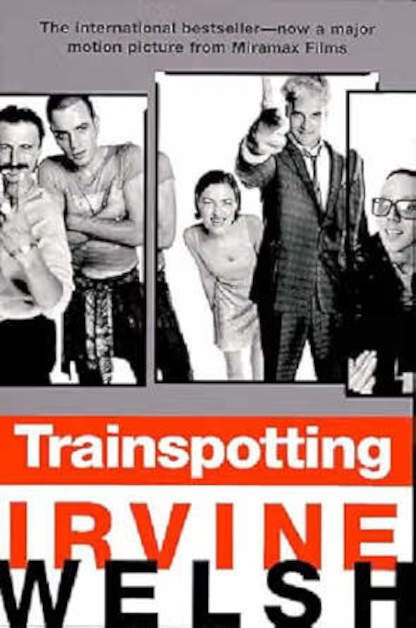
Trainspotting by Irvine Welsh is a story about Scotland in the 1990s. But it’s a story that makes the bagpipes sound like a harp by comparison, haggis taste like prime rib. It is dark. If the Scots had a tourism board, they would surely have paid to prevent this book’s publication. This is about poverty, degradation, war, desperation, heroin, and AIDS. It is not an easy book to read because of the bleakness of its subject and the raw intensity with which the author presents it, but also because of the author’s use of dense eye-dialect and in-group vernacular. The obstacles that the text itself presents to the reader seem intended to draw the reader in, to experience more immersively all the things his band of “radge bastards” experience. The reader’s effort is well rewarded.
I had seen the film adaptation at the Inwood in Dallas many years before, in 1996. It was an art-house theater and we enjoyed going there to take in whatever film was showing that week. It was usually something foreign, usually subtitled. Though “Trainspotting” (the film) was ostensibly in English, I found myself struggling with the dialect and thinking how helpful subtitles would be. As if the theater owner had read my mind, the subsequent scene was indeed subtitled, as it had become incomprehensible to the ear. The book does provide a (partial) glossary and it did get easier but the first few pages I read very slowly, just as I imagine Welsh intended. The content of the film was bleak; the Scotland it showed, dark; the critique of its people, scathing. Parts of it were harrowing. Asked on Monday what the movie was about, I said “Scotland sucks,” to which my colleague replied “Yes, I’ve heard that’s true.” (His wife was English.) I could never have imagined how toned down that movie had been compared to the book. Though there are significant differences between the film and the book, I consider the adaptation faithful to the book’s spirit. But some of the most horrifying parts were left on the page and some of the bite was removed in the screenwriting. Ewan McGregor never says the words “I hate the Scottish”—but Mark Renton certainly does.
There is a point in the book—not the film—where Renton reads Lovecraft on the train between Edinburgh and London. Renton is a reader. That he reads difficult books on philosophy is even a plot point. He reads books I’ve never read. But I read misanthropic Lovecraft—his dark stories of human degradation and helplessness in the face of forces unimaginable. Renton himself could almost be a Lovecraftian narrator. And invoking Lovecraft seems like a deliberate, oddly specific choice on the author’s part. There are similarities. Both authors write dense prose that seems intentionally difficult to read. Lovecraft also writes dark things, though never anything half so dark as the reality Renton inhabits. And where Lovecraft’s sentences are often circuitous, his words obscure and polysyllabic, his paragraphs sparse in dialogue; Welsh writes paragraphs that are mostly dialogue—his sentences clipped and staccato, his words no less cryptic but differently so. Where Lovecraft gestures toward the negative space surrounding some indescribable horror, Welsh force-feeds his horrors to the reader in vivid detail. Perhaps Welsh, also a reader of Lovecraft, secretly wishes he could fictionalize the horrors of Leith as cosmic monstrosities, but—unlike Lovecraft—he does not have this luxury. He can do no such thing.
What he does instead, he does well. This is a book worth the effort of reading.

Bonus illustration created by the book's prior owner.