Radio Free Albemuth, PK Dick (1976)
Posted on May 11, 2026 in blog
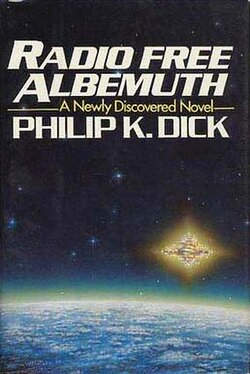
If an author casts himself as a central character, the dialogue he writes for himself cannot help being authentic but there are limits in the extent to which the resulting novel can genuinely remain fiction. In this novel, the author himself is a central character, through whose perspective much of the story is told. It is labeled as dystopian science fiction, but there is real doubt as to whether the author viewed it as fiction at all.
America’s dark prophet Philip K. Dick saw through the veil of perception that hangs before reality and stared unblinking into the abyss that lies beyond, seeing the world we have thus far only partly made our home.
It was in 1977, the year after he wrote this book, that Dick gave his speech titled “If You Find This World Bad, You Should See Some of the Others” in Metz, France. In this book, he describes one of those others.
In this speech, he describes his understanding of a theological “orthogonal time” in which reality is a superposition of all potential realities, a layering for which Heaven and Hell are its bookends. It is through this framework that he understands the words of Jesus, that the kingdom of God is not out there, not in the layers of Dante, but within you. He claims to have had a religious experience, a firsthand encounter with the divine, a look beyond our usual space of four dimensions—a reality in which his recent works are not so much fictional reality as alternative reality.
Elements of ‘Radio Free Albemuth’ are present in this speech. It certainly appears to be a creative work. It is an overtly political work. Perhaps it is also a work of apocryphal scripture.
In some regards, this writing is very much a product of its place and time: California in the 20th century. The story begins in Berkeley and ends in Orange County, framing them as the state’s antipodes. Some of the dry humor at Berkeley’s expense early in the novel is hilarious. Some elements have aged better than others. The cultural power of the popular music industry is not now what it was when this book was written. Yet in other ways, the author is perhaps more predictive of our time than descriptive of his own.
It probably doesn’t spoil the story to compare its ending to that of ‘A Scanner Darkly’ which was published in 1977. ‘Radio Free Albemuth’ was published posthumously in 1985. The ending of ‘A Scanner Darkly’ is powerful. While their endings are similar, the ending of ‘Radio Free Albemuth’ lands perhaps a little more softly. It is nonetheless solid and well-directed.
Whether it is better to read this novel before or after watching the author’s speech in Metz is unclear.