Gödel, Escher, Bach: an Eternal Golden Braid, Hofstadter (1979)
Posted on Jul 21, 2026 in book
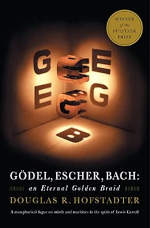
In the colophon of Gödel, Escher, Bach: an Eternal Golden Braid by Douglas Hofstadter, the publisher identifies this book’s genre as “metamathematics”. What distinguishes metamathematics from philosophy? I am not entirely sure. Perhaps it is the certain expectation of rigor. Given the breadth of subjects which this book sets out to pull together into a unified work, I myself can only call it philosophy.
And given the depth at which the author treats his subjects, it seems likely that most prospective readers would not feel completely comfortable and within their depth from the book's beginning until its end. I didn't. That’s okay. This is a firehose of a book. That is a feature, not a flaw. I once heard it said that “It is better to know everything about nothing than nothing about everything.” Certainly, this is not a view that I share and it is not a thing I can imagine this author ever saying.
All is connected.
The book’s greatest surprise (to me) is to be found in the colophon—in the fact that it was published in 1979. Given that much of what motivates this work is artificial intelligence, given how quickly that subject is changing today, and given how much it has changed in the intervening years since 1979; it is quite surprising that this book feels so fresh and so timely.
As a student, I learned what is now affectionately called “Old AI” from the book Principles of Artificial Intelligence by Nils J. Nilsson. A very different sort of book, that book had been published three years later than GEB, in 1982. While some facts have changed with time, no one would call GEB "old-anything" whether affectionalely or otherwise.
Brace yourself. But this book is well worth reading for anyone bold enough to stand before the firehose.