Dangerous Visions, Ellison (1967)
Posted on May 13, 2026 in blog
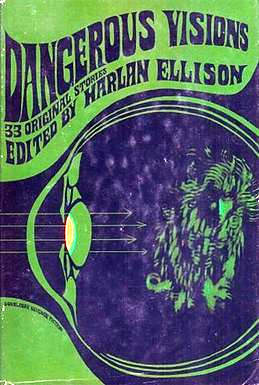
In producing ‘Dangerous Visions’ Harlan Ellison set out to create a speculative fiction collection that was different from others of its kind. It was to be different because it had been made differently.
Other anthologies were collected from among previously published works and those works had been selected and edited by the stodgy stiffs and squares who ran the periodicals that published them. Ellison’s stories would be new, avant-garde, mostly by young up-and-coming writers, ideally so bleeding edge as to have been unpublishable — radioactive.
It was the dawning of the Age of Aquarius. It was a dangerous time. The baby-boom had been dialed up to eleven and the youngest of them had just arrived at adulthood. Ellison looked to the writers among them and said “sock it to me”.
This is an unusual book, one composed of three different things. There are, of course, the stories themselves: short to medium length works of speculative fiction. Not all of them are strictly science fiction. Then there are the forewords, one introducing each story and two introducing the book as a whole. Most of these forewords were written by Ellison. Finally, there is an afterword that follows each story, each afterword prepared by the story’s author.
Let’s begin with the endings. One might imagine that in telling his story, an author will put everything he has into that story, not leaving much interesting to say in an afterword. This turns out to be the case. The afterwords are mostly short, mostly forgettable, and mostly — by me — forgotten.
The stories themselves vary greatly in content, style, and quality. Some are very much worth reading. Some are quite bizarre. As a whole, they are certainly worth having read.
The surprising part was in the forewords, especially as these were the non-fiction parts — well, nominally non-fiction, anyway — of what was, on the whole, a book of fiction. Mostly, these were written by Ellison, though the book begins with a foreword by Asimov. Also, Ellison’s own short fiction story is introduced by Bloch, whose story forms a sort of couplet with Ellison’s.
In some cases, the foreword is nearly as long as the story it introduces and this interstitial material forms a substantial part of the book. I enjoyed Ellison’s non-fiction contribution to this book more than his fiction.
It would be poor form for an anthologist to out-shine his invited authors. Ellison’s fiction didn’t do this. But if he had, I don’t imagine it would have bothered him. It’s my impression that spending time with this author would be less pleasant than reading his work. I suppose it’s only in the exceptional case that one would like both the bacon and the pig. The author himself advises against meeting writers whose work you admire. He does this using vivid insults which I assume didn’t apply to any of the other authors in this book. Or, at least I hope they didn’t.
As for whether this book and its vision are, for the present-day reader, dangerous; I would compare it to the Tyrannosaurus Rex in a natural history museum. It is significant. It is certainly interesting to look at. You can envision it giving quite a fright to the older and smaller reptiles on the primeval savanna. But, you yourself are probably in no real danger.